Queen Rania Ends Visit to Iran
(Office of Her Majesty, Press Department – Amman) Her Majesty Queen Rania Al Abdullah returned to Amman Tuesday following a two-day trip to the Islamic Republic of Iran, during which she met with Iran's First Lady, as well as other senior female Iranian officials working in various fields ranging from environment to family care.
The Queen and the accompanying delegation, which included Her Royal Highness Princess Alia Al Hussein, Minister of Social Development Mrs. Tamam Al Ghoul, and Senator Subhia Ma'ani, were warmly received by the Iranian officials and members of parliament.
The Queen's visit, which came in response to an invitation from Mrs. Zahra Sadiqi, the spouse of the Iranian President, included a meeting with the Presidential Advisor on Women's Affairs and President of the Center for Women's Participation Mrs. Zahra Shojaie.
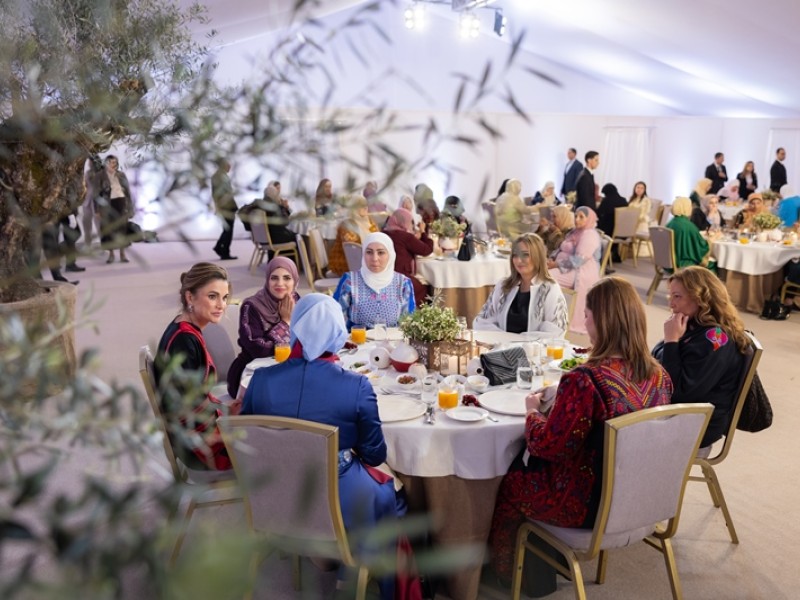
Iran's First Lady, who also shares the Queen's commitment to family issues and microfinance, hosted a dinner for the Queen on Monday night with Vice President of Iran Dr. Masouma Ibtikar, who presides over the Environmental Protection Organization, as well as with female members of the Iranian National Council.
During the dinner and her meetings over the two-day period, the Queen and the accompanying delegation were briefed on the status of women in Iran. Discussions also touched on the achievements of Jordanian and Iranian women, as well as their aspirations.
For her part, Queen Rania pointed to Iran's success in family health care and said she looks forward to further cooperation between Jordanian and Iranian women in all fields. The Queen added that Iran serves as an example of a Muslim country that has scored numerous achievements based on Islam and tradition.
As part of discussions with Iranian officials on issues of mutual interest, Queen Rania also visited the Family Planning Center in Tehran, which is supervised by the Ministry of Health and Medical Education. The Queen was briefed on the Iranian experience in family planning and health by the Director-General of the Primary Health Care Department at the Ministry of Health and Medical Education, Dr. Farid Abu Hussein.
Dr. Abu Hussein said that both Jordan and Iran serve as examples of Muslim countries with significant advances and successes in the health sector. He explained that through a strategy that draws on an integrated health-care network across the country, life expectancy in Iran rose from 55 in the early 80Õs to an average of 69 in 1997.
Iran's birth rate declined from 3.4% in the early 80's to 1.4% in 1997, said Dr. Abu Hussein, explaining that this decrease came about as a result of a concerted effort by the government and the people of Iran.
Iran's Second National Five-Year Development Plan, which began in 1994, had a strong family health component.
Health officials at the meeting attributed six factors for the success of Iran's family planning scheme: the support of the religious leaders, the commitment of the government, the empowerment of women, a wide health care network across the country, the active role of the community, and the support of international agencies.
Dr. Abu Hussein said that Iran has a population of 60 million people and that health houses have been set up to cater to the 23 million people living in rural areas, while health posts have been established for the 37 million people living in the urban areas of Iran.
Iran, which has a young population with married couples accounting for 15 million of the overall population, also has numerous counseling and awareness-raising programs with regards to family health.
Dr. Abu Hussein noted that Family Centers provide pre-marriage counseling to educate couples about family planning and post-delivery planning. Classes are also held for school students to learn about family health, he added.
During the two-day visit, the Queen and the accompanying delegation also visited the Amneh Center for Child Care in Tehran, as well as the Treasury of the National Jewels.
Featured

Queen Rania's official website
This website does not support old browsers. To view this website, Please upgrade your browser to IE 9 or greater
Your browser is out of date. It has known security flaws and may not display all features of this and other websites. Learn how to update your browser