
Madrasati

Going to school should be a memorable mixture of experiences:  learning and laughter, creativity and critical thinking, nurturing and increasing independence, enjoying today while planning for tomorrow. 

But in more than five hundred public schools across Jordan, for nearly 300,000 students, going to school is not as fun, enjoyable, or informative an experience as it should be. 

Pitted playgrounds, broken water taps, no shelter from the sun, dreary classrooms, not enough textbooks, light-fittings hanging from the wall, peeling paintwork…and more. 

Bright futures don’t start with days like this. 

Madrasati brings together businesses, non-governmental organizations, and communities, as well as the Ministry of Education, to rejuvenate schools in need. It joins businesspeople, parents, neighbors, and pupils in a common goal: quality education for Jordan’s children. 

It’s about sharing responsibility for our children’s education.  

And that takes many forms, because Madrasati is more than a one time, top-down infusion of resources.  More than repairing broken windows, providing new chairs, painting classrooms, and creating safe and fun playgrounds, Madrasati designs programs to enhance existing curricula and enrich every child’s learning for the long-term. 

Madrasati’s success has fostered a network of partners.  NGOs now offer expertise in issues like bullying and abuse; confidence and self-expression are inspired through drama classes, art, and problem solving in the local Children’s Museum; computers are installed and technical skills are taught by IT graduates who train teachers to ensure technologies liven up lessons, not lie latent; CEOs share their entrepreneurial experience and teach students how to find their dream job; and health and nutrition classes reach out to parents and children encouraging them to be more active and eat a balanced diet, together. 

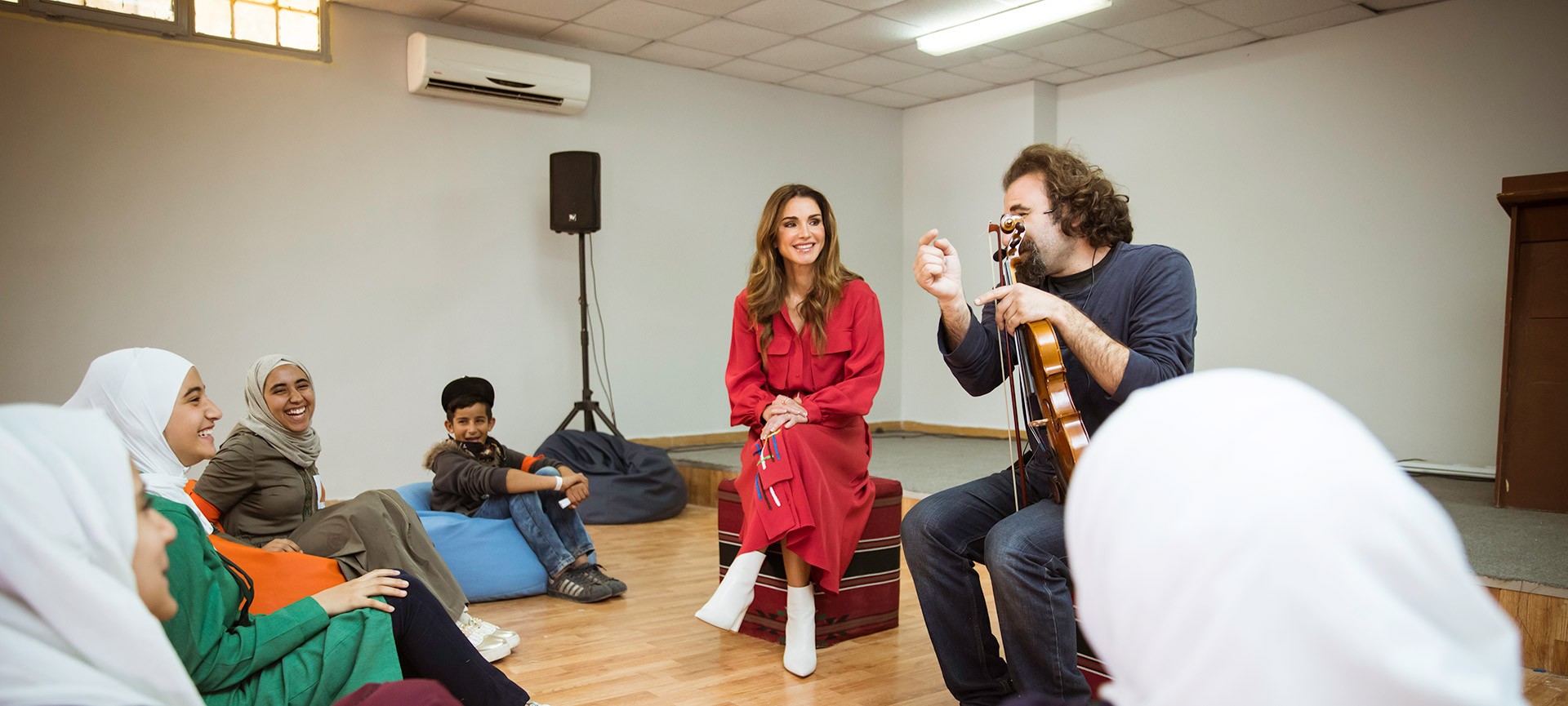
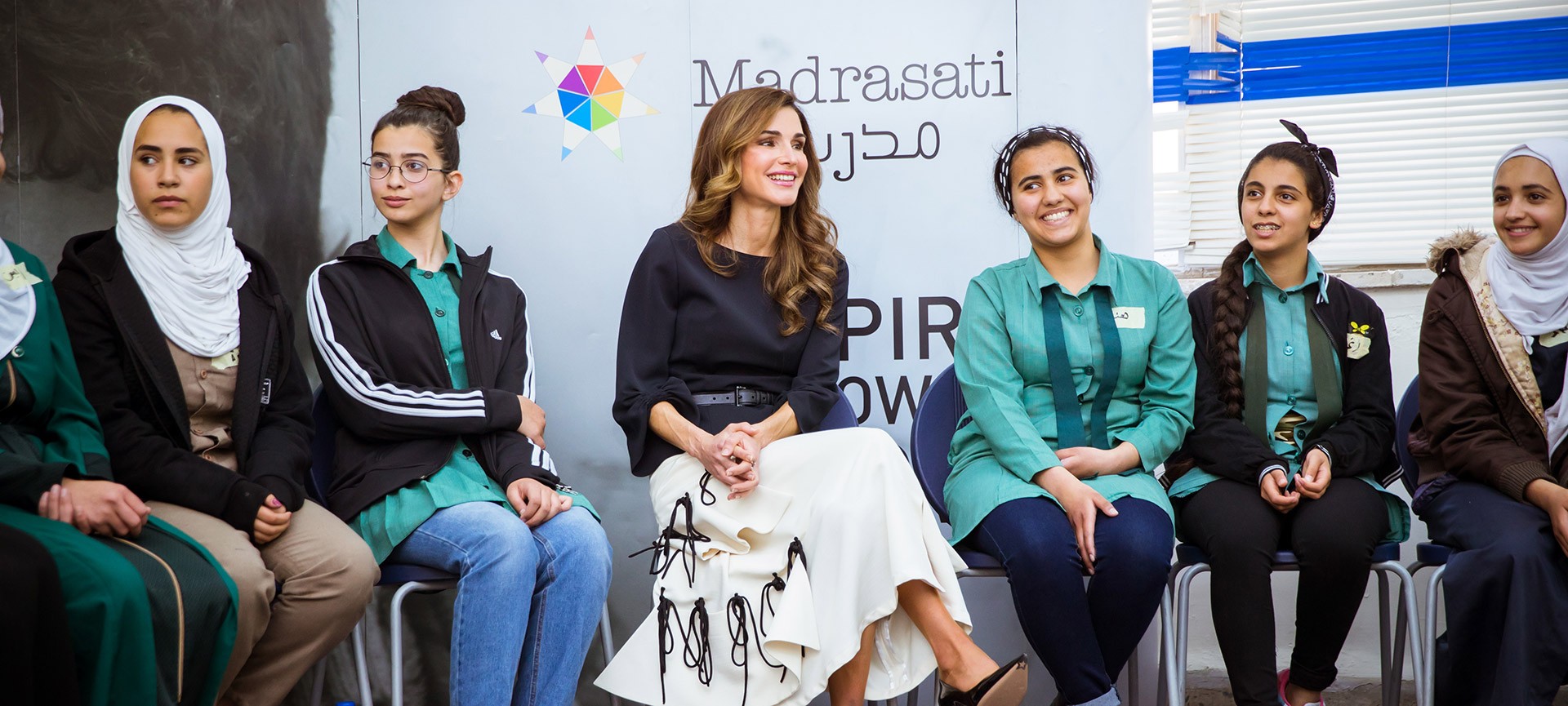
Each time I visit a Madrasati school, I see the emotional and psychological effect this initiative is having as well.  And I can’t help but smile.  It might be that children hold their heads up high as they walk into school, or they chatter excitedly in the playground; perhaps it’s a student’s face as she gazes at a bright, new mural, or it’s the brisk strides of teachers as they walk into their secure and clean classrooms; maybe it’s the eager eyes and the hands thrust high when a tutor asks for volunteers for a new project.  

Whatever it is, the atmosphere in a Madrasati school is positive; the teachers and students are happy; there’s a buzz of productivity and purpose.  That makes me proud.

But, there’s a lot more to do.  Madrasati must continue and grow.  With almost 40 per cent of our population under the age of fifteen, and an estimated 30 per cent of our young people unemployed, education is the key to unlocking our future prosperity. 

So far, we have revitalized and mobilized almost 200 schools and communities, and as of April 2010, we began work on another hundred. Our goal is five hundred schools in five years. But we cannot do it alone. The generous sponsorship of companies, NGOs, and government departments means that over 100,000 children are being reached by the Madrasati initiative. Others eagerly await their school to become a Madrasati school, but we need more support and more engagement from businesses and communities.

If you want to be part of the Madrasati movement, and join those making a difference for thousands of Jordan’s children, please log on to www.madrasati.jo

Thank you.


Comments (3)
To leave a comment, please login or register »
maisb
Wednesday, June 16, 2010

Your majesty Queen Rania ,

Thank you for providing time and money in making the education experiance more enjoyable and better in our beloved country Jordan .

I Have this IDEA that i wanted to share with all the readers , WHY can't we use the recycling methods in making books and notebooks ???

I believe this way we will save our country from pollutions and also encourage our student in using these methods in their daily life , also we spread awareness in the Jordan community about the fact of global warming and the pollution , besides we could save lots and lots of money in buying the teaching and studying equipments !!

Al Naimi
Thursday, April 8, 2010

All What we need is an integrated approach for Education Development based on a holistic and participatory methodology.

Let me start by referring to the past 5 years and the current situation in the education system in Jordan. Although there has been some selected progress in ERfKE I, there are only a few examples of systemic change where interventions are addressing existing conditions. The mindset of the education managers are not sufficiently in tune with the realities we face. In some respects, one can say they bring a 20th century perspective and capacity to 21st century issues that are very challenging. We need capable managerial skills as well as technical competence.

Efforts to improve the relevance of the curriculum to reflect current day realities have only been partially successful. There remains a dramatic need to have the curriculum enhanced and also taught and learned in a manner that develops student capability to compete internationally and to make the contributions required as citizens of this country. There is a dire need for effective school management and leadership as well as the required competence in the teaching-learning process. This requires a high level of managerial effectiveness at the district as well as the school level and a different kind of interaction with the communities the system is supposed to serve.

My project district and school programs, is the first glimpse of hope we have seen that has a real impact in changing existing conditions. It is definitely a reform program. It is one of the first initiatives that have drawn nothing but positive comments from everyone involved at the district, school and community levels. It is not simply trying to upgrade existing conditions. It aims at real system change. It has an in-built capacity to bring a new culture within the district and school organizations; it provides for relative objective consensus among stakeholders on existing conditions; and, it helps to set realistic targets to which all participants feel they can contribute. It sets in motion changes that are needed at the local level and it introduces civil society into the education process in meaningful and sustainable ways. It introduces agreement leading to accountability and provides for ongoing monitoring of progress and evaluation of the contributions. It is a system that addresses the required state of readiness needed in districts and schools in order to take advantage of reform initiatives and innovations that are more directed to improved teaching and learning.

What is lacking, however, are effective interactions with the central ministry organization and also the management capacity to manage an increasingly complex situation. We need to build managerial competence. It is important to enable distributed leadership so that change can occur at many levels and in many directions at the same time. Jordan requires a multi-dimensional reform ( tri- level) program that enables the central Ministry to support the already existing assignments at the district and school level and to gradually increase the extent of their responsibilities. The system has identified the need for structural organizational re-alignments at the district and school levels. We need the pressure for change from the application of the system in districts and schools to change the central ministry organization so that it is more responsive, more efficient and also more effective.

What can we do to assist? State of readiness in the broad range of district and school management functions along with the development of the capacity to enable the required changes is critical. From what we have seen, no other program has been able to provide this kind of support. After establishing the mechanisms to define the existing district and school conditions and the targets to lead to a more effective state of readiness, support to address areas of improvement priority. It is not surprising that my system has identified a range of system weaknesses that are common among the field directorates and also common among schools. Some of these are also common between schools and their district organization. Each of these areas need to be addressed throughout the Kingdom while at the same time enabling MOE to ensure the ERfKE I interventions can be adopted adequately and fully integrated at the classroom level.

We have a representative sample of 700 schools and 7 districts; the outcomes and the result of the self assessment which identified the common weakness can be generalized across the country. In this way, we will secure the equity that all schools will benefit from the pilot in those areas. The lesson learnt from the pilot should be addressing a simplified approach to reach all schools in the country equally in the life of erfke2.

My work in redefining the role of supervisors as education advisors as well as facilitators and principals as instructional leaders is very valuable (the work done with selective group of supervisors from Jerash, Al Badia Al Wosta and Marfraq. Further work to institutionalize new professional standards for these critical positions and to establish capacity building activities that provide for pre-qualification or re-certification of individuals in these positions would be very welcomed. And, if the program can be accredited with university standing it would also be something very beneficial to the individuals for their careers and also strengthen the forgotten role of the university contribution to basic and secondary education.

What is the priority? Please assist MOE to institutionalize the District and School program in all districts and in all schools. Please assist MOE to qualify the key persons in managing and guiding the system at the principal, supervisor and district official levels. Others are addressing pre service education for teachers even though we know that our system was the key contributor to facilitating universities and the Ministry to adopt new national teacher professional standards.

We know that my program is based on three distinct stages – first establishing and institutionalizing a self assessment methodology and self improvement program and then moving to interventions to address the improvement and development priorities. Identified a broad range of capacity building activities that are directed to school management, classroom instruction, student support services, and partnership with parents, community, business, municipal and governorate representatives, the third one which I didn’t implement introducing accountability system, which we started by introducing an agreement to lead to contract, but left before that. These need to be institutionalized. What is new in our program is the fact that you have enabled the local district office to launch its own professional development program for all local MOE personnel as well as for students. This means that training is more responsive to local needs and also more flexible in its delivery. We have also provided guidance on how teachers and principals can network with colleagues in other schools as part of communities of learning. My programs need to be expanded so that the progress made in establishing open and frank communications at all levels can become a way of life. These have tremendous potential to form sustainable alliances among all stakeholders in the districts that have benefited.

We want to continue the contribution in systemic change and system efficiency and effectiveness. The District and School Program provides this as well as bringing the community much closer to their potential roles in basic and secondary education. And, our program is the first to try to increase student and parent awareness on their responsibility for their own education and the thrust to overall quality standards.

Thank you

Fouza

saras_firas
Saturday, January 2, 2010

Unfortunately I can not help with money, but as a believer I say: may Allah help this kind of projects.